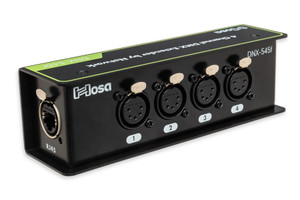


Hosa DNX-345 - Pro-Conex XLR-over-CAT Extenders (Box-to-Box Pair)
Hosa
$44.95
Write a Review

Hosa
Hosa DNX-345 - Pro-Conex XLR-over-CAT Extenders (Box-to-Box Pair)
Hosa DNX-345 - Pro-Conex XLR-over-CAT Extenders (Box-to-Box Pair)
Rugged steel box at each end. A female unit (DNX-345F) sits at the source; a male unit (DNX-345M) at the console. One EtherCON/EtherLOK shielded CAT cable between them as a 4-channel snake.
Need to get balanced audio or DMX from one end of a room — or one end of a building — to the other? The Hosa DNX Series carries it over standard shielded CAT cable: a temporary run across the venue floor, a ruggedized tour cable, or the structured cabling already in your walls. No bulky multicore snake, no custom runs — just clean, balanced signal over the CAT cable that fits the job.
Each extender collapses four balanced XLR channels into a single CAT cable. The DNX Series comes in two configurations: 3-pin models (DNX-300 Series) for analog audio, AES3, or DMX, and 5-pin models (DNX-500 Series) for DMX512 lighting control.
Passive "straight-wire" transmission. The DNX Series requires no external power and no digital conversion. It uses the twisted-pair architecture of standard CAT cabling to deliver four discrete channels of balanced signal. Because it operates purely on the physical layer, it delivers your signal with zero latency.
3-Pin Models — DNX-300 Series
The 3-pin DNX-300 units are signal-agnostic: whatever balanced signal you put on the XLR, they carry it over CAT. For analog, the signal never leaves the analog domain — a straight-wire path from XLR to RJ45 means no A/D conversion, no latency, and no coloration. What you put in is what you get out.
One box, three jobs
Analog Audio
Send four channels of balanced mic- or line-level audio over CAT. Ideal for stage-to-FOH runs, breakout rooms, and installs where pulling analog multicore isn't practical.
DMX / Lighting Data
Distribute DMX512 across your CAT backbone to reach fixtures and controllers anywhere on the network — without dedicated DMX cable to every position.
AES3 Digital Audio
Carry AES3 digital audio between consoles, processors, and interfaces over the same CAT infrastructure that handles everything else in the rack.
How it works: one unit at each end
Each DNX-300 extender is sold individually, and the XLR gender tells you which end it belongs on. A complete run uses one of each:
- Female XLR unit (DNX-345F) goes at the source end. Mic and line outputs are male, so they plug into its female inputs — your stage, instruments, or send.
- Male XLR unit (DNX-345M) goes at the destination end. Its male outputs feed the female inputs on your console, amp, or processor.
Run a single shielded CAT cable between the two units and you have a rugged four-channel analog snake — over the cable that suits the gig.
Features
- Four channels of balanced XLR over a single CAT cable
- Carries analog audio, AES3 digital audio, and DMX/lighting data
- Straight-wire analog path — no digital conversion, no coloration
- Passive design — no power supply required
- Works with any shielded CAT5e cable or higher
- Rugged, compact galvanized-steel enclosure built for the road
- Available in 3-pin male (XLR3M) or female (XLR3F) configurations
Specifications
- Series: Hosa DNX
- Channels: 4-Channel Balanced
- Transmission Medium: Shielded CAT5e, CAT6, or CAT7 Cable (STP/FTP)
- Connectors (CAT Interface): RJ45 (Ethercon Compatible)
- Connectors (Audio Model): 3-Pin XLR (Male or Female)
- Connectors (Lighting Model): 5-Pin XLR (Male or Female)
- Housing: Galvanized Steel Enclosure
Related Products
-

-
Hosa DNX-345M - DMX to Network Extender
$49.95$64.95 -
Hosa DNX-545F - DMX to Network Extender
$61.95$80.95 -
Hosa DNX-345F - DMX to Network Extender
$49.95$64.95